


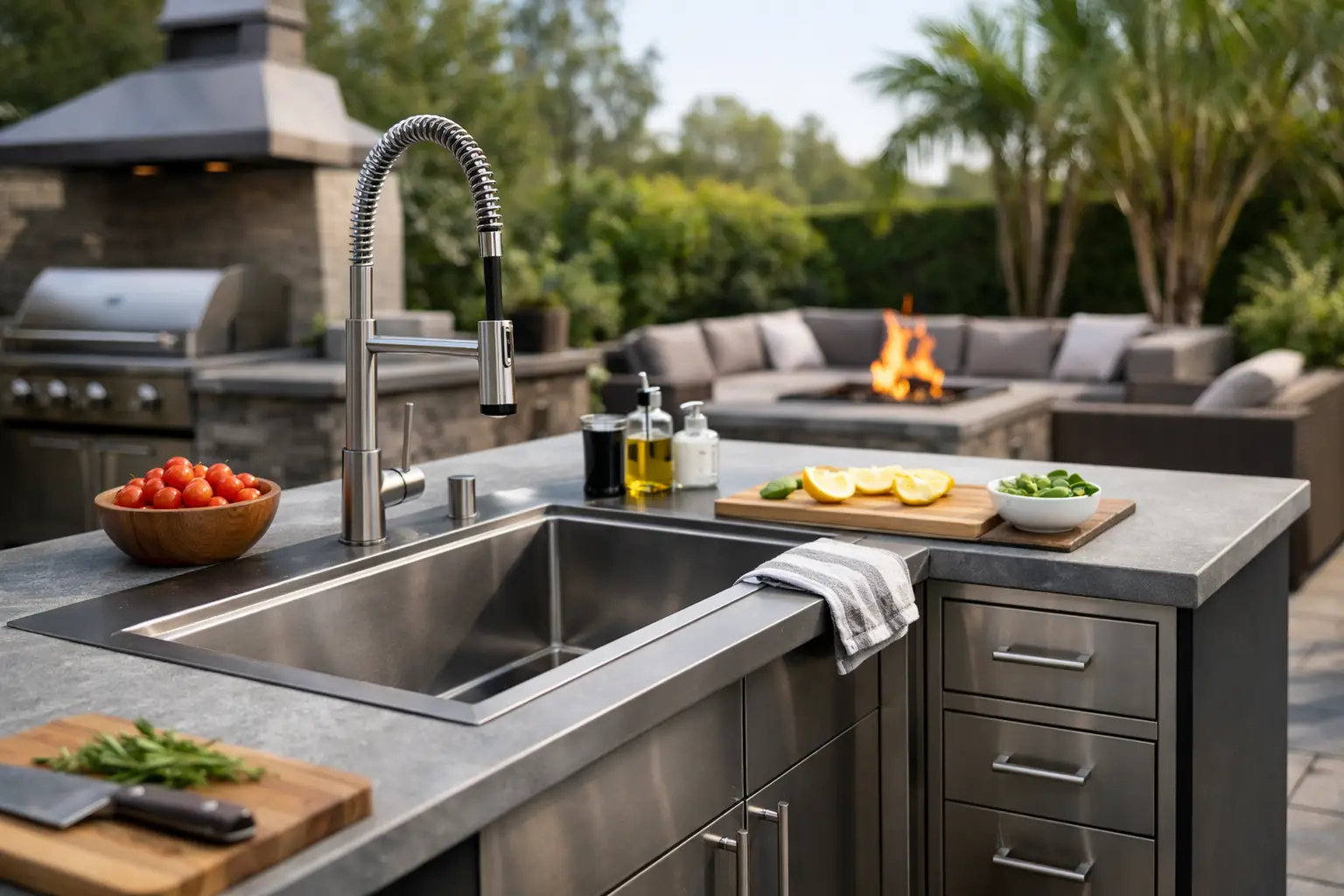
A sink tends to be the point where an outdoor kitchen starts behaving like a proper kitchen rather than a barbecue station with ambitions. If you prep vegetables outside, rinse herbs from the garden, wash hands between handling meat and serving, or keep glasses moving during a long summer gathering, an outdoor kitchen sink unit quickly earns its place.
For many UK homeowners, it is also the detail that makes the whole space feel complete. A well-chosen sink unit adds practical flow, cleaner work surfaces and a more polished finish overall. The question is not simply whether you need one, but which type will suit the way you cook, host and use your garden.
The best outdoor kitchens are built around ease. You want ingredients, tools, refrigeration, cooking and clean-up to work together without constant trips back through the house. An outdoor kitchen sink unit supports that rhythm.
It gives you a dedicated place for rinsing salad, filling pans, draining drinks buckets, washing utensils and dealing with quick spills before they become a mess across your cabinetry. If you entertain regularly, that convenience becomes part of the experience. Guests stay outside, the host stays present, and the evening keeps its pace.
There is also a hygiene benefit that should not be overlooked. If you are handling raw meat, fish or marinades, access to running water nearby is far more practical than relying on a jug or heading indoors every time. For serious grill enthusiasts, that alone can justify the addition.
Not every outdoor kitchen needs the same specification. If your setup is compact and mainly used for straightforward grilling, a sink may be less essential than extra prep space or storage. But once you move into a more complete outdoor cooking environment, the value changes.
A sink unit is especially worthwhile if you host often, cook with multiple ingredients, use side burners or plan to include refrigeration and worktops as part of a full kitchen run. It also makes sense for households that want the garden to feel like an extension of the home rather than a separate zone.
The trade-off is footprint. A sink cabinet takes up valuable width, and in smaller layouts every module has to earn its position. That is why planning matters. The right unit should support the way you move, not interrupt it.
The right choice usually comes down to five things: size, material, storage, plumbing and layout. None of them should be considered in isolation.
If your outdoor kitchen is built around weekend feasts, longer prep sessions and frequent entertaining, a larger bowl and more generous surrounding worktop will pay off. You will appreciate the space when cleaning grill tools, rinsing platters or preparing produce for a crowd.
If your cooking style is more relaxed and occasional, a compact sink unit may be enough. In that case, the goal is convenience without sacrificing too much prep area. A smaller module can still deliver the essentials while keeping the kitchen balanced.
Outdoor use changes the specification entirely. Your sink unit needs to cope with rain, changing temperatures and regular exposure to grease, moisture and cleaning products.
Stainless steel remains a strong choice for the sink itself because it is durable, easy to maintain and visually suited to contemporary outdoor kitchens. For cabinetry, weather-resistant construction is vital. You want a unit designed specifically for outdoor living, not something adapted from an indoor kitchen that will struggle once exposed to the elements.
This is where premium modular systems stand apart. Better materials hold their appearance, maintain structural integrity and sit more confidently alongside high-performance grills and appliances. In a design-led garden, consistency matters.
The cabinet below is not just there to support the basin. It can help organise cleaning products, bin storage, spare cloths or connection points for plumbing. A well-designed sink unit turns an awkward area into useful storage.
That said, under-sink storage will usually be more restricted than in a standard cabinet because pipework takes up room. If maximising storage is your priority, it may make sense to pair the sink with a separate drawer or cupboard module nearby. That gives you both convenience and capacity without forcing one cabinet to do everything.
This is often the point where ambition meets practical reality. A sink is straightforward to appreciate and more complex to install well.
A permanent outdoor kitchen sink unit typically needs both a clean water supply and wastewater drainage. If you are designing a full outdoor kitchen as part of a landscaping project or renovation, this is easiest to plan from the outset. Pipe runs, drainage falls and access can all be integrated into the build.
If you are retrofitting a sink into an existing patio kitchen, it depends on distance from the house, available services and how permanent you want the installation to be. In some gardens, the plumbing route is simple. In others, it can add meaningful cost and complexity.
For that reason, the sink should never be chosen in isolation from the broader layout. A stunning module in the wrong position may look right on paper and prove awkward in practice. Expert planning is worth having here, particularly when you are investing in a premium setup intended to last.
A sink works best when it supports prep and service rather than competing with the cooking area. In most layouts, it belongs close to your main preparation surface and within easy reach of the grill, but not so close that it creates congestion.
Think in terms of zones. You may have cold storage at one end, prep space and sink in the middle, and cooking appliances beyond. Or, in a larger arrangement, you might place the sink between prep and serving so it helps both functions. The best layout depends on whether your kitchen is designed primarily for cooking performance, entertaining flow or a blend of both.
If your outdoor kitchen includes refrigeration, the sink and fridge together can create a highly effective hosting zone. Drinks can be chilled, garnishes prepped and glasses rinsed without crossing the entire kitchen. That is the sort of detail that makes an outdoor space feel considered and effortless.
One of the clearest advantages of a modular outdoor kitchen is that the sink unit becomes part of a coherent system rather than a standalone add-on. It can align in finish, height, proportions and performance with your barbecue, storage modules and worktops.
That matters aesthetically, but it matters just as much functionally. Modular planning allows you to decide where the sink belongs in relation to cabinetry, appliances and circulation space. You are not forcing separate pieces to work together after the fact. You are building a kitchen that is meant to operate as one.
For customers creating a more refined garden setting, this is often the difference between something that feels pieced together and something that feels professionally designed. A premium sink unit should not look like a compromise. It should look integral to the whole composition.
The most common mistake is choosing a sink that is too small for the way the kitchen will be used. A compact bowl may seem sensible until you try to clean cooking grates, rinse large serving dishes or deal with prep for a full table of guests.
Another is underestimating plumbing requirements. The visual part of the project is the enjoyable part, but the practical services decide whether the kitchen is genuinely comfortable to use. It is also easy to overlook adjacent worktop space. A sink without enough landing area around it can become frustrating very quickly.
Finally, avoid treating the sink as a secondary afterthought. In a well-designed outdoor kitchen, it is part of the working core. Giving it the right position and specification improves the performance of everything around it.
If you are building a premium garden cooking space, the sink unit makes most sense when viewed as part of the wider system. That means considering grill choice, cabinet configuration, refrigeration, storage and dimensions together rather than one by one.
This is where a configurator-led approach becomes particularly useful. Being able to visualise modules, test layouts and understand live dimensions helps you judge whether a sink unit improves the kitchen or simply takes up room. At GRLLR, that joined-up planning is central to creating an outdoor kitchen that feels luxurious, practical and tailored to how you live.
The right outdoor kitchen sink unit should make hosting easier, cooking cleaner and the whole space feel more complete – not just for summer weekends, but for every occasion when the garden becomes the best room of the house.
